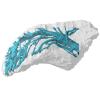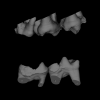
3D models of Cainotheriids Ossicular chain
Explodable 3D Dog Skull for Veterinary Education
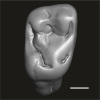
3D models of teeth and neurovascular system in the rostrum of Spinosauridae (theropod dinosaurs)
3D GM dataset of bird skeletal variation
Skeletal embryonic development in the catshark
Bony connexions of the petrosal bone of extant hippos
bony labyrinth (14) , inner ear (11) , Eocene (11) , geometric morphometrics (10) , CT-scan (10) , Oligocene (9) , Micro-CT (9)
Lionel Hautier (25) , Maëva Judith Orliac (24) , Laurent Marivaux (19) , Bastien Mennecart (16) , Renaud Lebrun (15) , Rodolphe Tabuce (15) , Pierre-Olivier Antoine (13)
Page 1 of 1, showing 1 record(s) out of 1 total
|
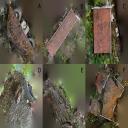
3D models related to the publication: New Cretaceous dinosaur track sites from the Jiaguan Formation, Sichuan Province, China: ichnotaxonomy and preservationLida Xing
Published online: 08/10/2026 |
|
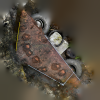
M3#1982All footprints in Fig. 6 are tridactyl theropod footprints assigned to Morphotype I and tentatively identified as Eubrontes-like. Fig. 6 (Hongyangoukou Slab 1) preserves at least 31 footprints, comprising seven trackways (HYGK-T1–T7) and 15 isolated footprints (HYGK-TI1–TI15). They are preserved as natural molds in reddish-brown siltstone and are heavily weathered, but they generally retain distinct tridactyl outlines and U- or V-shaped metatarsophalangeal regions. Claw impressions are present in some specimens (e.g., T3, T7-L1, and TI9), whereas digital pad impressions are absent. Footprint length ranges from 10.8 to 20.9 cm (mean ≈16.0 cm); the length-to-width ratio ranges from 1.1 to 1.7 (mean ≈1.4); mesaxony is weak (mean ≈0.47); and the divarication angle between digits II and IV ranges from 41° to 73° (mean ≈60°). The stride lengths of T1, T3, T4, and T6 are 144.5, 104.8, 122.3, and 64.5 cm, respectively, corresponding to 9.7, 5.6, 9.4, and 3.3 times their respective mean footprint lengths. T1 and T5 show outward rotations of about 4° and 9°, respectively. T3 is among the best-preserved examples, with digit III the longest and stoutest, digit IV the shortest, and clear claw impressions present on digits II and III, whereas TI10 is a complete tridactyl track. These footprints are therefore small theropod tracks of Morphotype I, tentatively assigned to Eubrontes-like. Type: "3D_surfaces"doi: 10.18563/m3.sf.1982 state:in_press |
Download 3D surface file |
Eubrontes isp. HYGK Slab 2 View specimen

|
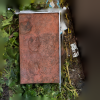
M3#1983All footprints in Fig. 7 (Hongyangoukou Slab 2) are tridactyl theropod footprints assigned to Morphotype II and tentatively identified as Eubrontes-like. Slab 2 preserves at least 28 footprints, including two trackways (HYGK-T8 and HYGK-T9) and 18 isolated footprints (HYGK-TI16–TI33). Preservation is poorer than on Slab 1: impressions are shallower and more rounded overall; in T9 and in some isolated footprints (e.g., TI17, TI18, TI20, TI23, TI24, and TI26), discrete digit impressions are not recognizable and instead appear as oval depressions, whereas the remaining footprints show three discernible digit impressions. No digital pad impressions were observed; the metatarsophalangeal region is U-shaped, and relatively clear claw impressions are preserved in some tracks, such as T8-R1, TI18, and TI31. Footprint length ranges from 11.2 to 21.6 cm (mean 15.1 cm); the length-to-width ratio ranges from 0.9 to 1.7 (mean 1.4); mesaxony is weak (mean 0.45); and the divarication angle between digits II and IV ranges from 46° to 62° (mean 54°). The stride lengths of T8 and T9 are 60 cm and 116 cm, corresponding to approximately 4 and 7.7 times the average footprint length, respectively; the pace angulation of T9 is 166°. TI31 is relatively well preserved and markedly symmetrical, with digit III being the stoutest and longest, and with a distinct, sharp claw impression. Type: "3D_surfaces"doi: 10.18563/m3.sf.1983 state:in_press |
Download 3D surface file |
Eubrontes isp. HYGK Slab 3 View specimen
|
M3#1984All footprints in Fig. 8 (Hongyangoukou Slab 3) are tridactyl theropod footprints assigned to Morphotype I and tentatively identified as Eubrontes-like. Slab 3 preserves at least seven isolated footprints (HYGK-TI34–TI40) and no trackways; these footprints have relatively distinct tridactyl outlines and U- or V-shaped metatarsophalangeal regions, with some specimens (e.g., TI37 and TI38) preserving claw impressions but lacking digital pad impressions. The divarication angle between digits II and IV on Slab 3 ranges from 53° to 57° (mean 56°). As members of Morphotype I, they fall within the morphotype ranges for footprint length (10.8–20.9 cm; mean 16.0 cm), length-to-width ratio (1.1–1.7; mean 1.4), and mesaxony (weak; mean 0.47). Type: "3D_surfaces"doi: 10.18563/m3.sf.1984 state:in_press |
Download 3D surface file |
Eubrontes isp. JYX-TI5 View specimen
|
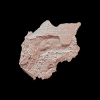
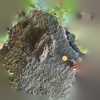
M3#1985JYX-TI5 is tentatively assigned to cf. Eubrontes. It is preserved as a natural cast on dark red quartz sandstone, with a preservation grade of 0.5–1.5. It shows largely complete digit impressions and a metatarsophalangeal region, as well as some claw impressions, but no digital pad impressions. The footprint has three distinct digit impressions, a relatively distinct U-shaped metatarsophalangeal region, a separation between the proximal region of digit III and the metatarsophalangeal region, and relatively clear claw impressions; its surface bears irregular linear ridges that likely represent microbially induced sedimentary structures (MISS). JYX-TI5 is 22.1 cm long, with a length-to-width ratio of 1.5, weak mesaxony (0.45), and a divarication angle between digits II and IV of 50°; the interdigital angle between digits II and III is slightly larger than that between digits III and IV. Type: "3D_surfaces"doi: 10.18563/m3.sf.1985 state:in_press |
Download 3D surface file |
Grallator isp. SMG25 Slab 1 View specimen
|
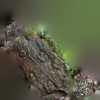
M3#1986Fig. 16 includes ornithopod footprints assigned to Caririchnium isp. and theropod footprints tentatively assigned to cf. Grallator. The ornithopod tracks are natural casts, clearest on Slab 1, and show a distinct quadripartite structure. Preservation grade is 1–2; footprint length is 23.5–31.2 cm (mean 27.3 cm), and length-to-width ratio is 1.2–1.5 (mean 1.4). They are highly symmetrical, with three clear rounded digit impressions and a sub-circular metatarsophalangeal region separated by a depression; claw impressions are absent, mesaxony is weak (0.24–0.38; mean 0.30), and the mean divarication angle between digits II and IV is 49°. The potential trackway SMG25-O2 has a pace length about 2.7 times the footprint length, a pace angulation of 111°, and inward rotation of about 15°. The theropod tracks are mostly isolated, with only one potential trackway, SMG25-T1, on Slab 1. Preservation grade is 1–2; footprints are small (8.5–20.4 cm) and generally slender, mostly complete tridactyl impressions with digit III longest and digit II shortest, V-shaped metatarsophalangeal regions, and faint claw impressions or digital pads in some tracks. SMG25-T1 comprises two footprints (mean length 19.9 cm, length-to-width ratio 1.9, mesaxony 0.54, mean divarication angle between digits II and IV 41°). Isolated footprint TI9 is the best preserved (length 9.8 cm, length-to-width ratio 2.1, mesaxony 0.72, divarication angle between digits II and IV 38°), with the metatarsophalangeal pad of digit IV aligned along the axis of digit III. Type: "3D_surfaces"doi: 10.18563/m3.sf.1986 state:in_press |
Download 3D surface file |
Grallator isp. SMG25 Slab 2 View specimen
|
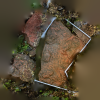
M3#1987cf. Grallator is the dominant ichnotaxon in Fig. 17, which preserves 12 isolated cf. Grallator footprints, all preserved as natural positive reliefs with preservation grade 1–2. These small theropod tracks are 8.5–20.4 cm long and generally slender, and are mostly complete tridactyl impressions with digit III longest and digit II shortest, V-shaped metatarsophalangeal regions, and faint claw impressions or digital pads in some specimens. Type: "3D_surfaces"doi: 10.18563/m3.sf.1987 state:in_press |
Download 3D surface file |
Page 1 of 1, showing 1 record(s) out of 1 total