Explodable 3D Dog Skull for Veterinary Education
3D models of teeth and neurovascular system in the rostrum of Spinosauridae (theropod dinosaurs)
3D models of Ocnotherium skull
3D GM dataset of bird skeletal variation
Skeletal embryonic development in the catshark
Bony connexions of the petrosal bone of extant hippos
bony labyrinth (14) , inner ear (11) , Eocene (11) , geometric morphometrics (10) , CT-scan (10) , Oligocene (9) , Micro-CT (9)
Lionel Hautier (25) , Maëva Judith Orliac (24) , Laurent Marivaux (19) , Bastien Mennecart (16) , Renaud Lebrun (15) , Rodolphe Tabuce (15) , Pierre-Olivier Antoine (13)
MorphoMuseuM, also referred to as M3, is a peer reviewed, online data journal that publishes 3D models of vertebrates, including models of type specimens, anatomy atlases, reconstruction of deformed or damaged specimens, and 3D datasets (see https://doi.org/10.1017/scs.2017.14 for details).
M3 comes along with a free software, MorphoDig, which contains a set of tools for editing, positioning, deforming, labelling, measuring and rendering sets of 3D surfaces.
All 3D data presented on this website are licensed under a Creative Commons Attribution-NonCommercial 4.0. International License. 
|
3D models related to the publication: What Jaws and Teeth Reveal: Tracing Fine-Scale Ecological Adaptation in Two Cypriot MiceMorgane Dubied
Published online: 14/10/2026 |
|
M3#1897Upper molar row APO1 Mus cypriacus Type: "3D_surfaces"doi: 10.18563/m3.sf.1897 state:in_press |
Download 3D surface file |
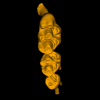
Mus cypriacus BET2 View specimen
|
M3#1898Upper molar row BET2 Mus cypriacus Type: "3D_surfaces"doi: 10.18563/m3.sf.1898 state:in_press |
Download 3D surface file |
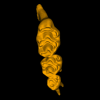
Mus cypriacus FON1 View specimen
|
M3#1899Upper molar row FON1 Mus cypriacus Type: "3D_surfaces"doi: 10.18563/m3.sf.1899 state:in_press |
Download 3D surface file |
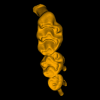
Mus cypriacus FON2 View specimen
|
M3#1900Upper molar row FON2 Mus cypriacus Type: "3D_surfaces"doi: 10.18563/m3.sf.1900 state:in_press |
Download 3D surface file |
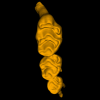
Mus cypriacus KOU1 View specimen
|
M3#1901Upper molar row KOU1 Mus cypriacus Type: "3D_surfaces"doi: 10.18563/m3.sf.1901 state:in_press |
Download 3D surface file |
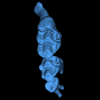
Mus musculus KOF1 View specimen
|
M3#1902Upper molar row KOF1 Mus musculus domesticus Type: "3D_surfaces"doi: 10.18563/m3.sf.1902 state:in_press |
Download 3D surface file |
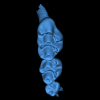
Mus musculus LEF1 View specimen
|
M3#1903Upper molar row LEF1 Mus musculus domesticus Type: "3D_surfaces"doi: 10.18563/m3.sf.1903 state:in_press |
Download 3D surface file |
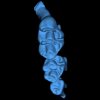
Mus musculus MEN1 View specimen
|
M3#1904Upper molar row MEN1 Mus musculus domesticus Type: "3D_surfaces"doi: 10.18563/m3.sf.1904 state:in_press |
Download 3D surface file |
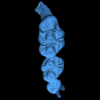
Mus musculus TSE2 View specimen
|
M3#1905Upper molar row TSE2 Mus musculus domesticus Type: "3D_surfaces"doi: 10.18563/m3.sf.1905 state:in_press |
Download 3D surface file |
Mus musculus XYL5 View specimen
|
M3#1906Upper molar row XYL5 Mus musculus domesticus Type: "3D_surfaces"doi: 10.18563/m3.sf.1906 state:in_press |
Download 3D surface file |
 , Charles Leriche, Mohd Waqas , Rajendra Rana , Ashok Sahni and Thierry Smith
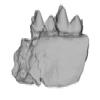
 This 3D dataset contains the 3D models of the fossil specimens of Lilliputia gujjarorum, a new tiny dichobunoid artiodactyl from the early middle Eocene of northwestern India. The material includes the holotype, GU/RJ/003 (Rajouri Collection, H.N.B. Garhwal University), consisting of an associated left mandible fragment preserving the distal part of p4 and m1–3 (GU/RJ/003a) and a left maxillary fragment preserving P4 and M1–3 (GU/RJ/003b), as well as the referred specimen GU/RJ/005, a right mandible fragment preserving m1–2. The exceptionally small body size of Lilliputia, among the smallest known in Artiodactyla, together with its mosaic of primitive and derived dental characters, provides new insights into the early evolution, palaeobiogeography, and ecological diversification of artiodactyls during the Eocene.
Lilliputia gujjarorum GU/RJ/003a View specimen
|
M3#1949left mandible fragment preserving the distal part of p4 and m1–3 Type: "3D_surfaces"doi: 10.18563/m3.sf.1949 state:in_press |
Download 3D surface file |
Lilliputia gujjarorum GU/RJ/003b View specimen
|
M3#1950left maxillary fragment preserving P4 and M1–3 Type: "3D_surfaces"doi: 10.18563/m3.sf.1950 state:in_press |
Download 3D surface file |
Lilliputia gujjarorum GU/RJ/005 View specimen
|
M3#1951right mandible fragment preserving m1–2 Type: "3D_surfaces"doi: 10.18563/m3.sf.1951 state:in_press |
Download 3D surface file |
 , Jens N. Lallensack , Junhong Mou, Lin Liu , Shan Jiang, Qi Qi , Anthony Romilio , Yong Ye, Xin Shen and Ting Xu
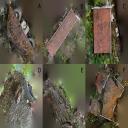
The present 3D dataset contains the 3D models analyzed in Xing et al. (in press), Newly discovered Cretaceous dinosaur track sites from the Jiaguan Formation, Sichuan Province, China: ichnotaxonomy and preservation. The dataset includes photogrammetric 3D models of the specimens shown in Figures 6–9 and 16–17 of the original article. These correspond to track-bearing slabs and selected footprints from the Hongyangoukou and Jinyuxi tracksites and the Shimiaogou 2025 tracksite in the Gulin area, Sichuan Province, China. The Hongyangoukou material comprises three reddish-brown siltstone slabs preserving at least 61 theropod tracks, including nine trackways (HYGK-T1 to HYGK-T9) and isolated footprints (HYGK-TI1 onward). The Jinyuxi material comprises one isolated theropod natural cast (JYX-TI5) assigned to cf. Eubrontes, associated with microbially induced sedimentary structures (MISS). The Shimiaogou 2025 material comprises two slabs preserving at least 25 dinosaur footprints, including ornithopod trackways SMG25-O1 and SMG25-O2, theropod trackway SMG25-T1, and isolated footprints; all occur as natural positive reliefs. The 3D surface models are provided in PLY format.
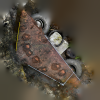
Eubrontes isp. HYGK Slab 1 View specimen
|
M3#1982All footprints in Fig. 6 are tridactyl theropod footprints assigned to Morphotype I and tentatively identified as Eubrontes-like. Fig. 6 (Hongyangoukou Slab 1) preserves at least 31 footprints, comprising seven trackways (HYGK-T1–T7) and 15 isolated footprints (HYGK-TI1–TI15). They are preserved as natural molds in reddish-brown siltstone and are heavily weathered, but they generally retain distinct tridactyl outlines and U- or V-shaped metatarsophalangeal regions. Claw impressions are present in some specimens (e.g., T3, T7-L1, and TI9), whereas digital pad impressions are absent. Footprint length ranges from 10.8 to 20.9 cm (mean ≈16.0 cm); the length-to-width ratio ranges from 1.1 to 1.7 (mean ≈1.4); mesaxony is weak (mean ≈0.47); and the divarication angle between digits II and IV ranges from 41° to 73° (mean ≈60°). The stride lengths of T1, T3, T4, and T6 are 144.5, 104.8, 122.3, and 64.5 cm, respectively, corresponding to 9.7, 5.6, 9.4, and 3.3 times their respective mean footprint lengths. T1 and T5 show outward rotations of about 4° and 9°, respectively. T3 is among the best-preserved examples, with digit III the longest and stoutest, digit IV the shortest, and clear claw impressions present on digits II and III, whereas TI10 is a complete tridactyl track. These footprints are therefore small theropod tracks of Morphotype I, tentatively assigned to Eubrontes-like. Type: "3D_surfaces"doi: 10.18563/m3.sf.1982 state:in_press |
Download 3D surface file |
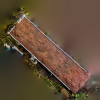
Eubrontes isp. HYGK Slab 2 View specimen
|
M3#1983All footprints in Fig. 7 (Hongyangoukou Slab 2) are tridactyl theropod footprints assigned to Morphotype II and tentatively identified as Eubrontes-like. Slab 2 preserves at least 28 footprints, including two trackways (HYGK-T8 and HYGK-T9) and 18 isolated footprints (HYGK-TI16–TI33). Preservation is poorer than on Slab 1: impressions are shallower and more rounded overall; in T9 and in some isolated footprints (e.g., TI17, TI18, TI20, TI23, TI24, and TI26), discrete digit impressions are not recognizable and instead appear as oval depressions, whereas the remaining footprints show three discernible digit impressions. No digital pad impressions were observed; the metatarsophalangeal region is U-shaped, and relatively clear claw impressions are preserved in some tracks, such as T8-R1, TI18, and TI31. Footprint length ranges from 11.2 to 21.6 cm (mean 15.1 cm); the length-to-width ratio ranges from 0.9 to 1.7 (mean 1.4); mesaxony is weak (mean 0.45); and the divarication angle between digits II and IV ranges from 46° to 62° (mean 54°). The stride lengths of T8 and T9 are 60 cm and 116 cm, corresponding to approximately 4 and 7.7 times the average footprint length, respectively; the pace angulation of T9 is 166°. TI31 is relatively well preserved and markedly symmetrical, with digit III being the stoutest and longest, and with a distinct, sharp claw impression. Type: "3D_surfaces"doi: 10.18563/m3.sf.1983 state:in_press |
Download 3D surface file |
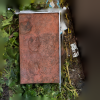
Eubrontes isp. HYGK Slab 3 View specimen
|
M3#1984All footprints in Fig. 8 (Hongyangoukou Slab 3) are tridactyl theropod footprints assigned to Morphotype I and tentatively identified as Eubrontes-like. Slab 3 preserves at least seven isolated footprints (HYGK-TI34–TI40) and no trackways; these footprints have relatively distinct tridactyl outlines and U- or V-shaped metatarsophalangeal regions, with some specimens (e.g., TI37 and TI38) preserving claw impressions but lacking digital pad impressions. The divarication angle between digits II and IV on Slab 3 ranges from 53° to 57° (mean 56°). As members of Morphotype I, they fall within the morphotype ranges for footprint length (10.8–20.9 cm; mean 16.0 cm), length-to-width ratio (1.1–1.7; mean 1.4), and mesaxony (weak; mean 0.47). Type: "3D_surfaces"doi: 10.18563/m3.sf.1984 state:in_press |
Download 3D surface file |
Eubrontes isp. JYX-TI5 View specimen
|
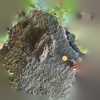
M3#1985JYX-TI5 is tentatively assigned to cf. Eubrontes. It is preserved as a natural cast on dark red quartz sandstone, with a preservation grade of 0.5–1.5. It shows largely complete digit impressions and a metatarsophalangeal region, as well as some claw impressions, but no digital pad impressions. The footprint has three distinct digit impressions, a relatively distinct U-shaped metatarsophalangeal region, a separation between the proximal region of digit III and the metatarsophalangeal region, and relatively clear claw impressions; its surface bears irregular linear ridges that likely represent microbially induced sedimentary structures (MISS). JYX-TI5 is 22.1 cm long, with a length-to-width ratio of 1.5, weak mesaxony (0.45), and a divarication angle between digits II and IV of 50°; the interdigital angle between digits II and III is slightly larger than that between digits III and IV. Type: "3D_surfaces"doi: 10.18563/m3.sf.1985 state:in_press |
Download 3D surface file |
Grallator isp. SMG25 Slab 1 View specimen
|
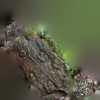
M3#1986Fig. 16 includes ornithopod footprints assigned to Caririchnium isp. and theropod footprints tentatively assigned to cf. Grallator. The ornithopod tracks are natural casts, clearest on Slab 1, and show a distinct quadripartite structure. Preservation grade is 1–2; footprint length is 23.5–31.2 cm (mean 27.3 cm), and length-to-width ratio is 1.2–1.5 (mean 1.4). They are highly symmetrical, with three clear rounded digit impressions and a sub-circular metatarsophalangeal region separated by a depression; claw impressions are absent, mesaxony is weak (0.24–0.38; mean 0.30), and the mean divarication angle between digits II and IV is 49°. The potential trackway SMG25-O2 has a pace length about 2.7 times the footprint length, a pace angulation of 111°, and inward rotation of about 15°. The theropod tracks are mostly isolated, with only one potential trackway, SMG25-T1, on Slab 1. Preservation grade is 1–2; footprints are small (8.5–20.4 cm) and generally slender, mostly complete tridactyl impressions with digit III longest and digit II shortest, V-shaped metatarsophalangeal regions, and faint claw impressions or digital pads in some tracks. SMG25-T1 comprises two footprints (mean length 19.9 cm, length-to-width ratio 1.9, mesaxony 0.54, mean divarication angle between digits II and IV 41°). Isolated footprint TI9 is the best preserved (length 9.8 cm, length-to-width ratio 2.1, mesaxony 0.72, divarication angle between digits II and IV 38°), with the metatarsophalangeal pad of digit IV aligned along the axis of digit III. Type: "3D_surfaces"doi: 10.18563/m3.sf.1986 state:in_press |
Download 3D surface file |
Grallator isp. SMG25 Slab 2 View specimen
|
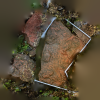
M3#1987cf. Grallator is the dominant ichnotaxon in Fig. 17, which preserves 12 isolated cf. Grallator footprints, all preserved as natural positive reliefs with preservation grade 1–2. These small theropod tracks are 8.5–20.4 cm long and generally slender, and are mostly complete tridactyl impressions with digit III longest and digit II shortest, V-shaped metatarsophalangeal regions, and faint claw impressions or digital pads in some specimens. Type: "3D_surfaces"doi: 10.18563/m3.sf.1987 state:in_press |
Download 3D surface file |
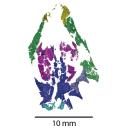 , Juan C. Sotomayor Chacón , María R. Arcaria , Nahuel Vega, Juan M. Leardi , Federico D. Seoane and Alejandro Otero
This contribution contains the 3D dataset analyzed in L. C. Gaetano, J. C. Sotomayor Chacón, M. R. Arcaria, N. Vega, J. M. Leardi, F. D. Seoane, and A. Otero. submitted. Earliest-diverging rhynchocephalian from Gondwana: a new sphenodontian from the Upper Triassic Los Colorados Formation (northwestern Argentina). Scientific Reports.
Coloradosphenodon lahni PULR-V264 View specimen
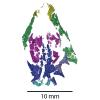
|
M3#1855fragmentary skull and lower jaws Type: "3D_surfaces"doi: 10.18563/m3.sf.1855 state:in_press |
Download 3D surface file |
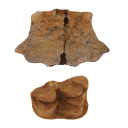 , Cyril Gagnaison , Bastien Mennecart , Réjanne Le Bivic and Maxime Denis
 The present 3D Dataset contains 3D models (1 turtle and 7 mammals) from the french Lower Miocene described in: Gagnaison C., Mennecart B., Bailleul J., Barrier P., Chenot É., Toullec R., Potel S., Martin H., Millet A. & Memeteau D. 2023. — Nouvelles données géologiques et biostratigraphiques du gisement paléontologique à vertébrés de Mauvières, à Marcilly-sur-Maulne (Miocène inférieur et moyen ; Indre-et-Loire, France). Geodiversitas 45 (16): 449-478. https://doi.org/10.5252/geodiversitas2023v45a16.
Testudo promarginata ULB-MAUV-5 View specimen
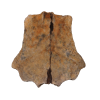
|
M3#1941Fragment of turtle shell of Testudo promarginata Type: "3D_surfaces"doi: 10.18563/m3.sf.1941 state:in_press |
Download 3D surface file |
Plesiaceratherium sp. ULB-MAUV-20 View specimen
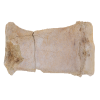
|
M3#1942right metacarpus III of Plesiaceratherium sp. Type: "3D_surfaces"doi: 10.18563/m3.sf.1942 state:in_press |
Download 3D surface file |
Brachyodus intermedius ULB-MAUV-21 View specimen
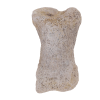
|
M3#1943phalanx II of the lateral finger (III or IV) of Brachyodus intermedius (Mayet, 1908) Type: "3D_surfaces"doi: 10.18563/m3.sf.1943 state:in_press |
Download 3D surface file |
Brachyodus intermedius ULB-MAUV-31 View specimen
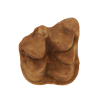
|
M3#1944cast of the right M3 of Brachyodus intermedius (Mayet, 1908) Type: "3D_surfaces"doi: 10.18563/m3.sf.1944 state:in_press |
Download 3D surface file |
Ligeromeryx praestans ULB-MAUV-24 View specimen
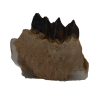
|
M3#1945right lower jaw bearing p3-m1 of Ligeromeryx praestans (Stehlin, 1937) Type: "3D_surfaces"doi: 10.18563/m3.sf.1945 state:in_press |
Download 3D surface file |
Ligeromeryx praestans ULB-MAUV-25 View specimen
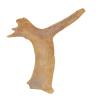
|
M3#1946cast of the right antler of Ligeromeryx praestans (Stehlin, 1937) Type: "3D_surfaces"doi: 10.18563/m3.sf.1946 state:in_press |
Download 3D surface file |
Megamphicyon carnutense ULB-MAUV-16 View specimen
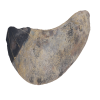
|
M3#1947right I1 of Megamphicyon carnutense (Antunes & Ginsburg, 1977) Type: "3D_surfaces"doi: 10.18563/m3.sf.1947 state:in_press |
Download 3D surface file |
Hemicyon gargan ULB-MAUV-18 View specimen
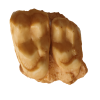
|
M3#1948cast of a left maxilla bearing M1-2 of Hemicyon gargan (Ginsburg & Morales, 1998) Type: "3D_surfaces"doi: 10.18563/m3.sf.1948 state:in_press |
Download 3D surface file |
 , Fanny Celestin, Sylvain Adnet and Guillaume Guinot
 The present 3D Dataset contains the 3D models produced for the paper "Szczygielski, T., Celestin, F., Adnet, S., Guinot, G., 2026. Triassic turtles of France: the first European Rhaetian stem turtle taxon (clades Testudinata, Proterochersidae). Swiss Journal of Palaeontology". The digitized material consists of shell and appendicular skeleton fragments of the first diagnostic stem turtle from the European Rhaetian and showcases a number of autapomorphic characters.
Bartassochersis lopezi UM-PDE2-01 View specimen
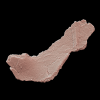
|
M3#1907Left axillary region and base of the anterior plastral lobe (left hyoplastron, small medial fragment of the right hyoplastron, part of the posterior process of the entoplastron) Type: "3D_surfaces"doi: 10.18563/m3.sf.1907 state:in_press |
Download 3D surface file |
Bartassochersis lopezi UM-PDE2-02 View specimen
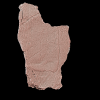
|
M3#1908Posterior plastral lobe Type: "3D_surfaces"doi: 10.18563/m3.sf.1908 state:in_press |
Download 3D surface file |
Bartassochersis lopezi UM-PDE2-03 View specimen
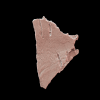
|
M3#1909First vertebral scute region, right side Type: "3D_surfaces"doi: 10.18563/m3.sf.1909 state:in_press |
Download 3D surface file |
Bartassochersis lopezi UM-PDE2-04 View specimen
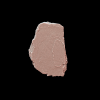
|
M3#1910?Carapace fragment Type: "3D_surfaces"doi: 10.18563/m3.sf.1910 state:in_press |
Download 3D surface file |
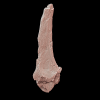
Bartassochersis lopezi UM-PDE2-05 View specimen
|
M3#1911Left scapula Type: "3D_surfaces"doi: 10.18563/m3.sf.1911 state:in_press |
Download 3D surface file |
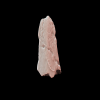
Bartassochersis lopezi UM-PDE2-06 View specimen
|
M3#1912Ungual Type: "3D_surfaces"doi: 10.18563/m3.sf.1912 state:in_press |
Download 3D surface file |
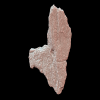
Bartassochersis lopezi UM-PDE2-08 View specimen
|
M3#1913Right hypoplastron Type: "3D_surfaces"doi: 10.18563/m3.sf.1913 state:in_press |
Download 3D surface file |
Bartassochersis lopezi UM-PDE2-09 View specimen
|
M3#1914Indeterminate Type: "3D_surfaces"doi: 10.18563/m3.sf.1914 state:in_press |
Download 3D surface file |
Bartassochersis lopezi UM-PDE2-10 View specimen
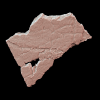
|
M3#1915?Mesoplastron/hypoplastron Type: "3D_surfaces"doi: 10.18563/m3.sf.1915 state:in_press |
Download 3D surface file |
Bartassochersis lopezi UM-PDE2-11 View specimen
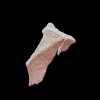
|
M3#1916Left inguinal periphery (peripheral, hyoplastron) Type: "3D_surfaces"doi: 10.18563/m3.sf.1916 state:in_press |
Download 3D surface file |
Bartassochersis lopezi UM-PDE2-12 View specimen
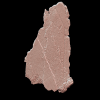
|
M3#1917?Left side of a vertebral scute area with two partial pleural scute areas Type: "3D_surfaces"doi: 10.18563/m3.sf.1917 state:in_press |
Download 3D surface file |
Bartassochersis lopezi UM-PDE2-13 View specimen
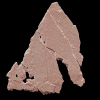
|
M3#1918?Posterior pleural and supramarginal of marginal areas Type: "3D_surfaces"doi: 10.18563/m3.sf.1918 state:in_press |
Download 3D surface file |
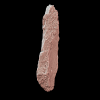
Bartassochersis lopezi UM-PDE2-14 View specimen
|
M3#1919Posterior peripherals Type: "3D_surfaces"doi: 10.18563/m3.sf.1919 state:in_press |
Download 3D surface file |
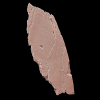
Bartassochersis lopezi UM-PDE2-15A View specimen
|
M3#1920?Left edge of the anterior plastral lobe Type: "3D_surfaces"doi: 10.18563/m3.sf.1920 state:in_press |
Download 3D surface file |
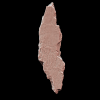
Bartassochersis lopezi UM-PDE2-15B View specimen
|
M3#1921Indeterminate Type: "3D_surfaces"doi: 10.18563/m3.sf.1921 state:in_press |
Download 3D surface file |
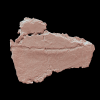
Bartassochersis lopezi UM-PDE2-16 View specimen
|
M3#1922Indeterminate Type: "3D_surfaces"doi: 10.18563/m3.sf.1922 state:in_press |
Download 3D surface file |
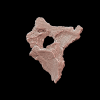
Bartassochersis lopezi UM-PDE2-17 View specimen
|
M3#1923?Bridge fragment Type: "3D_surfaces"doi: 10.18563/m3.sf.1923 state:in_press |
Download 3D surface file |
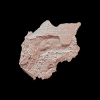
Bartassochersis lopezi UM-PDE2-19 View specimen
|
M3#1924Right bridge region Type: "3D_surfaces"doi: 10.18563/m3.sf.1924 state:in_press |
Download 3D surface file |
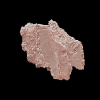
Bartassochersis lopezi UM-PDE2-20 View specimen
|
M3#1925Left femoral bulge Type: "3D_surfaces"doi: 10.18563/m3.sf.1925 state:in_press |
Download 3D surface file |
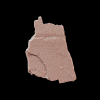
Bartassochersis lopezi UM-PDE2-21 View specimen
|
M3#1926Indeterminate Type: "3D_surfaces"doi: 10.18563/m3.sf.1926 state:in_press |
Download 3D surface file |
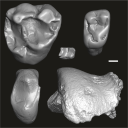 , Francisco R. Negri and Ana M. Ribeiro
 This contribution contains the three-dimensional digital models of fossil remains of platyrrhine primates from the late Middle to early Late Miocene (Upper Solimões Formation) of the State of Acre, Brazil (Western Amazonia). These fossils were described, figured and discussed in the following publication: Marivaux et al. (2026), New records of platyrrhine primates (Atelidae and Cebidae) from the Miocene of Western Amazonia, State of Acre, Brazil. Journal of Mammalian Evolution https://doi.org/10.1007/s10914-026-09829-z
Parabrachyteles vesperus UFAC-CS 488 View specimen
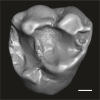
|
M3#1865Isolated right M1 or M2 Type: "3D_surfaces"doi: 10.18563/m3.sf.1865 state:in_press |
Download 3D surface file |
Migmacebus juruaensis UFAC-CS 487 View specimen
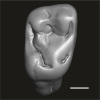
|
M3#1866Isolated right M1 or M2 Type: "3D_surfaces"doi: 10.18563/m3.sf.1866 state:in_press |
Download 3D surface file |
Gen indet sp. indet UFAC-CS 076 View specimen
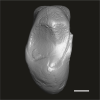
|
M3#1867Isolated right P3 or P4 Type: "3D_surfaces"doi: 10.18563/m3.sf.1867 state:in_press |
Download 3D surface file |
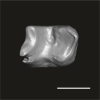
Gen indet sp. indet UFAC-CS 428 View specimen
|
M3#1868Isolated left m1 or m2 Type: "3D_surfaces"doi: 10.18563/m3.sf.1868 state:in_press |
Download 3D surface file |
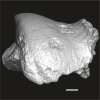
Gen indet sp. indet UFAC-CS 213 View specimen
|
M3#1869Fragment of left talus Type: "3D_surfaces"doi: 10.18563/m3.sf.1869 state:in_press |
Download 3D surface file |
 , Sandrine Ladevèze and Rodolphe Tabuce
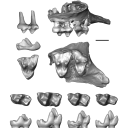
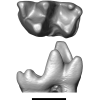
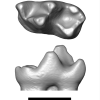
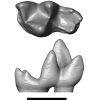
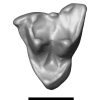
 This contribution contains three-dimensional models of the holotypes of Europeradectes marivauxi Gernelle, 2026, and E. williamsoni Gernelle, 2026, as well as other fossil material referred to these species from their type locality, Prémontré (Paris Basin; late early Eocene, 50.4-50.3 Ma). These specimens, among the youngest known for Europeradectes Gernelle, 2026, were analyzed and discussed in: Gernelle et al. (2026), A comprehensive evolutionary history of Peradectidae (Mammalia: Metatheria) revealed by a new dental morphology-based phylogenetic framework, with insights from late early Eocene French specimens.
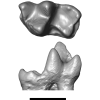
Europeradectes williamsoni MNHN.F.PRE26 View specimen
|
M3#1889right m3 (holotype) Type: "3D_surfaces"doi: 10.18563/m3.sf.1889 state:in_press |
Download 3D surface file |
Europeradectes williamsoni MNHN.F.PRE643 View specimen
|
M3#1890left m2 Type: "3D_surfaces"doi: 10.18563/m3.sf.1890 state:in_press |
Download 3D surface file |
Europeradectes williamsoni MNHN.F.PRE272 View specimen
|
M3#1891right m1 Type: "3D_surfaces"doi: 10.18563/m3.sf.1891 state:in_press |
Download 3D surface file |
Europeradectes williamsoni MNHN.F.PMT167 View specimen
|
M3#1892left m4 Type: "3D_surfaces"doi: 10.18563/m3.sf.1892 state:in_press |
Download 3D surface file |
Europeradectes marivauxi MNHN.F.PMT169 View specimen
|
M3#1893left M2 Type: "3D_surfaces"doi: 10.18563/m3.sf.1893 state:in_press |
Download 3D surface file |
Europeradectes marivauxi MNHN.F.PMT166 View specimen
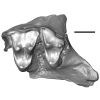
|
M3#1894partial right maxilla with M3-M4 (holotype) Type: "3D_surfaces"doi: 10.18563/m3.sf.1894 state:in_press |
Download 3D surface file |
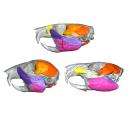 , Marcos A. Alves , Léa Da Cunha and Benoit Moison
 This contribution contains the 3D models described and figured in the following publication: Hautier L, Da Cunha L, Alves Filho M, Moison B, Besson L, Fabre P-H. 20XX. A 3D atlas of the trigeminal nerve and its relevance for comparative studies of the masticatory apparatus in rodents. Journal of Anatomy
Rattus norvegicus UM-ZOOL-3105 View specimen
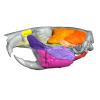
|
M3#19363D reconstruction of the masticatory musculature, trigeminal nerve and skull of the brown rat Rattus norvegicus Type: "3D_surfaces"doi: 10.18563/m3.sf.1936 state:in_press |
Download 3D surface file |
Cavia porcellus UM-ZOOL-499V View specimen
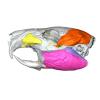
|
M3#19353D reconstruction of the masticatory musculature, trigeminal nerve and skull of the Guinea pig Cavia porcellus Type: "3D_surfaces"doi: 10.18563/m3.sf.1935 state:in_press |
Download 3D surface file |
Sciurus vulgaris BOUM-2022.2.12 View specimen
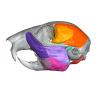
|
M3#19373D reconstruction of the masticatory musculature, trigeminal nerve and skull of the red squirrel Sciurus vulgaris Type: "3D_surfaces"doi: 10.18563/m3.sf.1937 state:in_press |
Download 3D surface file |
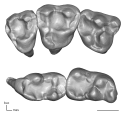 , Andreas Lang and Thomas Martin
The present dataset contains the 3D models of the cheek teeth of eight raccoons analyzed in Koomen, S. E., Lang, A. J. & Martin, T. (2026). Tooth Function of the Northern Raccoon (Procyon lotor) and Adaptations to Omnivory in the Order Carnivora. Journal of Morphology.
Procyon lotor ZFMK-MAM-2013.0341 View specimen
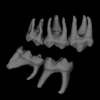
|
M3#1838Cheek teeth of P. lotor specimen ZFMK-MAM-2013.0341 Type: "3D_surfaces"doi: 10.18563/m3.sf.1838 state:in_press |
Download 3D surface file |
Procyon lotor ZFMK-MAM-1993.0289 View specimen
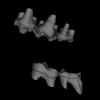
|
M3#1839Cheek teeth of P. lotor specimen ZFMK-MAM-1993.0289 Type: "3D_surfaces"doi: 10.18563/m3.sf.1839 state:in_press |
Download 3D surface file |
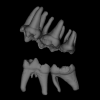
Procyon lotor ZFMK-MAM-2016.0912 View specimen
|
M3#1840Cheek teeth of P. lotor specimen ZFMK-MAM-2016.0912 Type: "3D_surfaces"doi: 10.18563/m3.sf.1840 state:in_press |
Download 3D surface file |
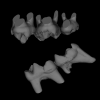
Procyon lotor ZFMK-MAM-2016.0914 View specimen
|
M3#1841Cheek teeth of P. lotor specimen ZFMK-MAM-2016.0914 Type: "3D_surfaces"doi: 10.18563/m3.sf.1841 state:in_press |
Download 3D surface file |
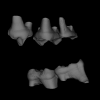
Procyon lotor ZFMK-MAM-2016.0923 View specimen
|
M3#1842Cheek teeth of P. lotor specimen ZFMK-MAM-2016.0923 Type: "3D_surfaces"doi: 10.18563/m3.sf.1842 state:in_press |
Download 3D surface file |
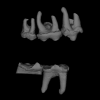
Procyon lotor ZFMK-MAM-2016.0937 View specimen
|
M3#1843Cheek teeth of P. lotor specimen ZFMK-MAM-2016.0937 Type: "3D_surfaces"doi: 10.18563/m3.sf.1843 state:in_press |
Download 3D surface file |
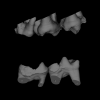
Procyon lotor ZFMK-MAM-2016.0938 View specimen
|
M3#1844Cheek teeth of P. lotor specimen ZFMK-MAM-2016.0938 Type: "3D_surfaces"doi: 10.18563/m3.sf.1844 state:in_press |
Download 3D surface file |
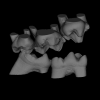
Procyon lotor ZFMK-MAM-2016.0967 View specimen
|
M3#1845Cheek teeth of P. lotor specimen ZFMK-MAM-2016.0967 Type: "3D_surfaces"doi: 10.18563/m3.sf.1845 state:in_press |
Download 3D surface file |
|
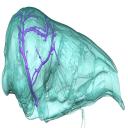
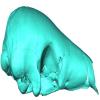
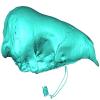
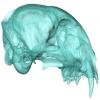
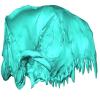
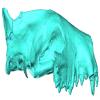
3D models related to the publication: Brain drain: exceptional pattern of calvarial venation in pangolins and its phylogenetic significance for FeraeGuillaume Billet
Published online: 26/03/2026 |
|
M3#1847cranium & intradiploic canals (sinuses & diploic veins) Type: "3D_surfaces"doi: 10.18563/m3.sf.1847 state:published |
Download 3D surface file |
Manis javanica NHM-UK 9.1.5.858 View specimen
|
M3#1848cranium & intradiploic canals (sinuses & diploic veins) Type: "3D_surfaces"doi: 10.18563/m3.sf.1848 state:published |
Download 3D surface file |
Felis silvestris UM-ZOOL-149N View specimen
|
M3#1849cranium & intradiploic canals (sinuses & diploic veins) Type: "3D_surfaces"doi: 10.18563/m3.sf.1849 state:published |
Download 3D surface file |
Erinaceus europaeus SMNS40759 View specimen
|
M3#1850cranium & intradiploic canals (sinuses & diploic veins) Type: "3D_surfaces"doi: 10.18563/m3.sf.1850 state:published |
Download 3D surface file |
Pterodon dasyuroides MNHN.F.Qu8301 View specimen
|
M3#1851cranium & intradiploic canals (sinuses & diploic veins) Type: "3D_surfaces"doi: 10.18563/m3.sf.1851 state:published |
Download 3D surface file |
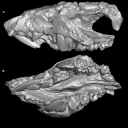 , Ana M. Ribeiro , Anne-Lise Charruault , Myriam Boivin , François Pujos , Rodolfo Salas-Gismondi , Laurent Marivaux and Pierre-Olivier Antoine
 This contribution contains the 3D digital models of some fossil specimens of Wamradolops telloi Stutz and Pozodolops manuelorum Stutz (Metatheria: Polydolopimorphia), from several Palaeogene locations of Peruvian Amazonia. These taxa were described and analyzed in detail in the following publication: Stutz et al. (2026), Hidden diversity of Palaeogene metatherians: a new family of polydolopimorphian marsupials from Peruvian Amazonia. Zoological Journal of the Linnean Society. https://doi.org/10.1093/zoolinnean/zlag006.
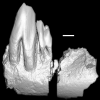
Pozodolops manuelorum MUSM 4029 View specimen
|
M3#1874Pozodolops manuelorum, fragmentary left dentary with p3–m1 Type: "3D_surfaces"doi: 10.18563/m3.sf.1874 state:published |
Download 3D surface file |
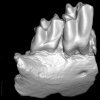
Wamradolops telloi MUSM 4032 View specimen
|
M3#1875Wamradolops telloi, fragmentary right dentary with m1–m2 Type: "3D_surfaces"doi: 10.18563/m3.sf.1875 state:published |
Download 3D surface file |
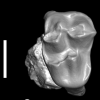
Pozodolops manuelorum MUSM 4036 View specimen
|
M3#1876Pozodolops manuelorum, holotype, fragmentary right maxilla with M1 Type: "3D_surfaces"doi: 10.18563/m3.sf.1876 state:published |
Download 3D surface file |
Pozodolops manuelorum MUSM 4041 View specimen
|
M3#1877Pozodolops manuelorum, fragmentary right dentary with m1 Type: "3D_surfaces"doi: 10.18563/m3.sf.1877 state:published |
Download 3D surface file |
Pozodolops manuelorum MUSM 4058 View specimen
|
M3#1878Pozodolops manuelorum, fragmentary left P3 Type: "3D_surfaces"doi: 10.18563/m3.sf.1878 state:published |
Download 3D surface file |
Wamradolops telloi MUSM 4144 View specimen
|
M3#1879Wamradolops telloi, fragmentary left dentary with p2–m1 Type: "3D_surfaces"doi: 10.18563/m3.sf.1879 state:published |
Download 3D surface file |
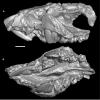
Wamradolops telloi MUSM 4179 View specimen
|
M3#1880Wamradolops telloi, holotype, partial skull, with right P2–M4 and left I4–M3, plus boneless lower teeth below upper teeth, belonging to the same individual Type: "3D_surfaces"doi: 10.18563/m3.sf.1880 state:published |
Download 3D surface file |
Wamradolops telloi MUSM 4221 View specimen
|
M3#1881Wamradolops telloi, fragmentary of right dentary with p3–m2 Type: "3D_surfaces"doi: 10.18563/m3.sf.1881 state:published |
Download 3D surface file |
 , Lucas N. Weaver , Kai R. K. Jäger and David M. Grossnickle
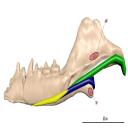
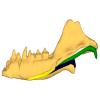
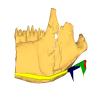
 The present dataset contains 3D models used for illustration purposes in Schultz, J. A., Weaver, L. N., Jäger, K. R. K. & Grossnickle, D. M., 2026. Reexamining the evolutionary history of the mammalian medial pterygoid muscle. Evolution. The dataset includes 3D models based on micro-computed tomography (µCT) data of the postdentary area of the morganucodontan Morganucodon, the docodontan Docodon, the eutriconodontan Priacodon and the cladotherian Dryolestes. In addition, the dataset includes manually reconstructed schematic 3D models of the middle ear bones for the morganucodontan Morganucodon, the docodontan Docodon, the eutriconodontan Priacodon and schematic middle ear bones and a virtually rendered juvenile lower jaw of a juvenile monotreme Ornithorhynchus (based on illustrations of Zeller [1989]).
Morganucodon sp. NHM M84028 View specimen
|
M3#1883Lower jaw with manually reconstructed Meckel’s cartilage and schematic middle ear bones (Ectotympanic, Articular/part of Malleus, Surangular/ part of Malleus) Type: "3D_surfaces"doi: 10.18563/m3.sf.1883 state:published |
Download 3D surface file |
Priacodon fruitaensis LACM 120451 View specimen
|
M3#1884Lower jaw with manually reconstructed Meckel’s cartilage and schematic middle ear bones (Ectotympanic, Articular/part of Malleus, Surangular/part of Malleus) Type: "3D_surfaces"doi: 10.18563/m3.sf.1884 state:published |
Download 3D surface file |
Dryolestes leiriensis GuiMam 3-78 View specimen
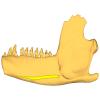
|
M3#1888Lower jaw with manually reconstructed schematic Meckel’s cartilage Type: "3D_surfaces"doi: 10.18563/m3.sf.1888 state:published |
Download 3D surface file |
Docodon victor YPM10649, YPM13735, YPM11823 and YPM11826 View specimen
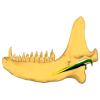
|
M3#1886Lower jaw with manually reconstructed Meckel’s cartilage and schematic middle ear bones (Ectotympanic, Articular/part of Malleus, Surangular/part of Malleus), for specification of jaw see Schultz et al. (2019) Type: "3D_surfaces"doi: 10.18563/m3.sf.1886 state:published |
Download 3D surface file |
Ornithorhynchus anatinus S32167 View specimen
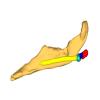
|
M3#1887Lower jaw with manually reconstructed Meckel’s cartilage and schematic middle ear bones (Prearticular, Articular/part of the Malleus, Surangular/part of Malleus, Angular/Incus) Type: "3D_surfaces"doi: 10.18563/m3.sf.1887 state:published |
Download 3D surface file |
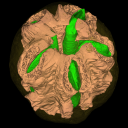 , Fabiani Herrera , Steven Manchester , Maëva J. Orliac , Renaud Lebrun and Cédric Del Rio
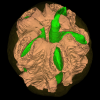
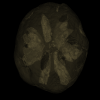
 The present 3D Dataset contains the 3D models of two endocarps from the Oligocene of Baraval Quercy locality. These endocarps document new fossil genera within the Anacardiaceae family and illustrate the morphological diversity of this family during the Palaeogene. The CT-scan data were processed with ImageJ and Mimics Innovation Suite version 1.13 to reconstruct the specimens. Here we provide .stl files easy to read with the software Meshlab.
Palaeochoerospondias sheppeyensis UM-BAV-675 View specimen
|
M3#1895Surfaces of the endocarp, seeds and lacunae Type: "3D_surfaces"doi: 10.18563/m3.sf.1895 state:published |
Download 3D surface file |
Baravalosphaera operculata UM-BAV-689 View specimen
|
M3#1896Surfaces of the endocarp Type: "3D_surfaces"doi: 10.18563/m3.sf.1896 state:published |
Download 3D surface file |
 , Maëva J. Orliac , Renaud Lebrun and Cédric Del Rio
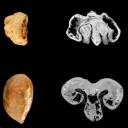
 The present 3D dataset contains the 3D models of two fossil seeds of Vitaceae from the Quercy fossiliferous area, southwestern France. One seed comes from the Eocene locality of Fontoffre 2, and the other from the Oligocene locality of Baraval. These seeds document new fossil species within the Vitaceae family and illustrate the morphological diversity of this family during the Palaeogene. The CT scan data were processed with ImageJ and Mimics Innovation Suite version 1.13 to reconstruct the specimens. Here we provide .stl files that can be easily opened with the software MeshLab.
Vitis quercyensis UM-FTF2-167 View specimen
|
M3#1930Surface of the seed Type: "3D_surfaces"doi: 10.18563/m3.sf.1930 state:published |
Download 3D surface file |
|
M3#1933Seed : 8.43 μm µCT scan Type: "3D_CT"doi: 10.18563/m3.sf.1933 state:published |
Download CT data |
Vitis praerotundifolia UM-BAV-660 View specimen
|
M3#1931Seed : 8.43 μm µCT scan Type: "3D_CT"doi: 10.18563/m3.sf.1931 state:published |
Download CT data |
|
M3#1932Surface of the seed Type: "3D_surfaces"doi: 10.18563/m3.sf.1932 state:published |
Download 3D surface file |
 and Florent Goussard
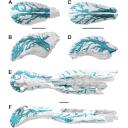
 The present 3D Dataset contains the 3D models of three specimens of Spinosauridae: two Cristatusaurus lapparenti Taquet & Russell, 1998 (MNHN.F.GDF365 and MNHN.F.GDF366) and one Spinosaurus maroccanus Russell, 1996 (MNHN.F.SAM124). These specimens are analyzed and discussed in Pittet F. 2026. Neurovascular system and dental renewal in the rostrum of Spinosauridae: new descriptions and implications on non-olfactive snout sensitivity of dinosaurs, Geodiversitas.
Cristatusaurus lapparenti MNHN.F.GDF365 View specimen
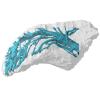
|
M3#1755Right and left premaxillae of MNHN.F.GDF365 (mature specimen of Cristatusaurus lapparenti): bony surface, teeth and neurovascular system Type: "3D_surfaces"doi: 10.18563/m3.sf.1755 state:published |
Download 3D surface file |
Spinosaurus maroccanus MNHN.F.SAM124 View specimen
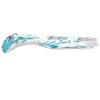
|
M3#1756Premaxillae and maxillae of MNHN.F.SAM124 (Spinosaurus maroccanus): bony surface, teeth and neurovascular system Type: "3D_surfaces"doi: 10.18563/m3.sf.1756 state:published |
Download 3D surface file |
Cristatusaurus lapparenti MNHN.F.GDF366 View specimen
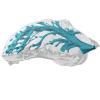
|
M3#1757Right and left premaxillae of MNHN.F.GDF366 (young specimen of Cristatusaurus lapparenti): bony surface, teeth and neurovascular system Type: "3D_surfaces"doi: 10.18563/m3.sf.1757 state:published |
Download 3D surface file |
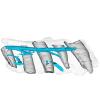
|
M3#1758Right maxilla portion of MNHN.F.GDF366 (young specimen of Cristatusaurus lapparenti): bony surface, teeth and neurovascular system Type: "3D_surfaces"doi: 10.18563/m3.sf.1758 state:published |
Download 3D surface file |
 and Juan D. Porfiri
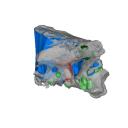
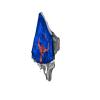
 The present 3D Dataset contains the 3D models analyzed in the following publication: Paulina-Carabajal, A., and Porfiri, J.D. 2026. Novel information on the braincase of Megaraptor namunhuaiquii (Dinosauria: Theropoda) using X-ray tomography: pneumaticity, paleoneurology and their paleobiological implications. Ameghiniana 63(1), 16-32
Megaraptor namunhuaiquii MUC-PV 595 View specimen
|
M3#18733D models of the braincase, lateral wall of the braincase, brain, right and left inner ears Type: "3D_surfaces"doi: 10.18563/m3.sf.1873 state:published |
Download 3D surface file |