|
3D models related to the publication: A new, tiny dichobunoid artiodactyl from the Eocene of India revisits the lower body size limit in artiodactyls
Published online: 14/10/2026
Keywords:
Body mass; Dispersal corridors; Mammals; Phylogeny; Subathu Formation
https://doi.org/10.18563/journal.m3.312
Cite this article:
Romain Weppe, Charles Leriche, Mohd Waqas, Rajendra Rana, Ashok Sahni and Thierry Smith, 2026. 3D models related to the publication: A new, tiny dichobunoid artiodactyl from the Eocene of India revisits the lower body size limit in artiodactyls. MorphoMuseuM e312. doi: 10.18563/journal.m3.312
Export citation
Abstract
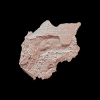
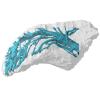
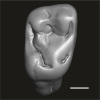
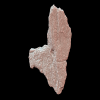
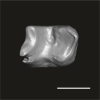
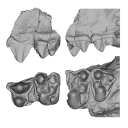
This 3D dataset contains the 3D models of the fossil specimens of Lilliputia gujjarorum, a new tiny dichobunoid artiodactyl from the early middle Eocene of northwestern India. The material includes the holotype, GU/RJ/003 (Rajouri Collection, H.N.B. Garhwal University), consisting of an associated left mandible fragment preserving the distal part of p4 and m1–3 (GU/RJ/003a) and a left maxillary fragment preserving P4 and M1–3 (GU/RJ/003b), as well as the referred specimen GU/RJ/005, a right mandible fragment preserving m1–2. The exceptionally small body size of Lilliputia, among the smallest known in Artiodactyla, together with its mosaic of primitive and derived dental characters, provides new insights into the early evolution, palaeobiogeography, and ecological diversification of artiodactyls during the Eocene.
M3 article infos
Article state: in_press
|
PDF
|